

4 reasons why stainless steel is better than powder-coated medical cabinets
A lot of questions and decisions sit behind the build of a new medical facility; such as a hospital, nuclear room, or a medical suite. One of those decisions include choosing the best surface finish for appliances and furniture. When it comes to medical storage cabinets for instance, whether if they need to be lead lined or not, there are two options: 1) stainless steel and 2) powder-coat. Here are four reasons why stainless-steel surface finishes are a definite must for your next medical build.
1. Sterility
Withholding a clean working environment is essential for medical settings to avoid disease, infectious contaminants, and bacteria. And so, sterility is at the top of the health priority list. With stainless steel being non-porous as opposed to powder coat having micro-pores, medical staff don’t have to worry about cleaning an “uneven” surface.
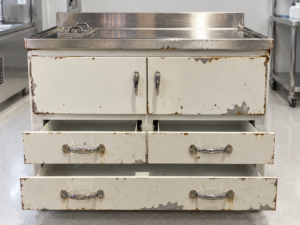
Think of your skin also having pores and how the accumulation of oil, dust, and sweat throughout the day could lead to you breaking out if you do not wash your face properly. Although, the main reason as to why stainless steel is greater than powder coated medical cabinets, is that it doesn’t crack, chip, or get damaged after 3-5 years of repeated use and cleaning procedures. And so, after years of wear the cracks and divots create uneven surfaces that trap contaminations making it harder to clean.
In return, this can contaminate surfaces & medical environments, which can then impact a patient’s life. This reason alone is enough for us experts to favour a clean & smooth-edged stainless-steel surface.
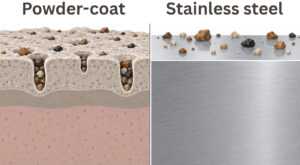
Powder-coat surfaces trap contamination in their pores and micro-cracks, making thorough cleaning increasingly difficult over time. Stainless steel keeps contaminants on the surface where they can be wiped away completely.
2. Corrosion Resistance
This second point also ties in well with sterility. To keep a safer work environment, harsher chemicals are used to clean surfaces. And again, stainless steel surfaces don’t deteriorate and break down the same way powder-coats do. As the powdered layer breaks down it can expose the raw materials under it, which can then cause rust to form around the chipped edges.
Think of a car getting scratched and segments of the paint being damaged due to the impact. Even after adding another layer of paint and leveling it out, the damage is already done. It’ll never be as good as the original build. It works the same way for powder-coat cabinets, except that exposed raw materials, even if its painted over, rust can form.
And so, the lack of corrosion resistance doesn’t favour powdered cabinets because they may end up causing more harm than good. This may not be a problem for several years, but as the cabinet ages with cleaning, chips/dents are inevitable. Stainless steel finishes don’t produce that worry.
3. Quicker Inspection Approval
Inspections are conducted to assess the “risk” component of a room build and assess its safety readiness for personnel and patients alike. One of the best ways to reduce these “flags” when it comes to cabinetry and other appliance surfaces is to have a flat easy-to-clean surface material, like stainless-steel, with no sharp edges or other ways to negatively contaminate work environments.
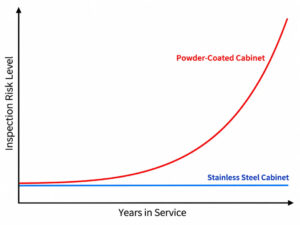
Let’s be clear, a powder-coat cabinet can pass inspection just fine the first several times. The only issue is caused by the repeated use and the decay, which then leads to slower approval rates. You can almost image an exponential curve (as the image below suggests) with the x axis as years of service & the y axis as inspection risk level let’s say for the first 7 years or so.
The Canadian Nuclear Safety Commission (CNSC) are the ones who oversea nuclear inspections. Depending on your facility’s track record (compliance record, licence type, isotope handling), inspections may happen more regularly every year, or less frequently in cycles of every three years.
Some of the factors they look for are as follows:
- Working surface integrity
- Contamination control
- Waste handling
- Storage conditions
- Record keeping, etc.
At Ultraray, we understand that passing inspection may be a worrying process and so we always opt to offer the best advice as possible, and trust our 40 years of shielding experience, stainless steel is the preferred option. For one project, because it was so humid the cabinets were never able to fully dry even after 1-2 weeks, which delayed delivery and significantly increased lead times.
4. Longer Product Life
When talking about products price and affordability is usually always a factor, but for medical products, such as lead-lined cabinets for instance, it can be very hard to compare. One day, you might have a stainless-steal finish cost less than a powder-coat layer for the same specs or vice versa. Although, one factor that remains consistent when comparing both cabinet finishes is how long each last.
As the exponential curve concept displays, stainless-steel cabinets have little to no inspection risks in the first 5-7 years of service because the cabinets can usually last around 15 to 20 years vs. maybe 5-8 years for powder-coat cabinets before needing a replacement.
Let’s look at some theoretical pricing comparisons:
Scenario 1:
|
Cabinet Type |
Unit Cost |
Replacements (16 yrs) |
Total Cost |
|
Powder-coated, 5yr life |
$1,000 |
3x |
$3,000 |
|
Powder-coated, 8yr life |
$1,000 |
2x |
$2,000 |
|
Stainless steel, 15yr life |
$1,500 |
2x |
$3,000 |
|
Stainless steel, 20yr life |
$1,500 |
1x |
$1,500 |
Scenario 2:
|
Cabinet Type |
Unit Cost |
Replacements (20 yrs) |
Total Cost |
|
Powder-coated, 5yr life |
$1,000 |
3x |
$3,000 |
|
Powder-coated, 8yr life |
$1,000 |
2x |
$2,000 |
|
Stainless steel, 15yr life |
$1,100 |
2x |
$3,000 |
|
Stainless steel, 20yr life |
$1,100 |
1x |
$1,100 |
Comparison Table
|
Cabinet Type |
Unit Cost |
Replacements (45 yrs) |
Total Cost |
|
Powder-coated, 5yr life |
$1,000 |
9x |
$9,000 |
|
Powder-coated, 8yr life |
$1,000 |
5x |
$5,000 |
|
Stainless steel, 15yr life |
$1,500 |
3x |
$4,500 |
|
Stainless steel, 15yr life |
$1,100 |
3x |
$3,000 |
|
Stainless steel, 20yr life |
$1,500 |
2x |
$3,000 |
|
Stainless steel, 20yr life |
$1,100 |
2x |
$2,200 |
With these tables laid out, it becomes increasingly more logical to go with stainless steel cabinets when planning for the medical building’s future. The last comparison table showcases a comparative cost rate for a build that lasts 45 years. Keep in mind, the cost comparisons are for 1 single cabinet unit so the costs skyrocket more when you account for all units you may need to replace.
By comparing the best-case scenario for the product life longevity of a powdered cabinet (~8 years) vs. the shorter life span of a stainless steel one (~15yrs) over the span of 45 years for 10 units at a price ratio of 1:1.5, here is what it looks like:
Powder Coat
$1,000/unit x 10 units x 5 replacements = $50,000
Stainless Steel
$1,500/unit x 10 units x 3 replacements = $45,000
**doesn’t account for the initially installed unit, these are just replacement cost comparisons.
So, even in the most unforgiving scenario it is still more logical to choose a stainless-steel cabinet finish because its longer product life expectancy gives it such a monetary advantage in a majority of scenarios compared to powder coat finishes.
Summary
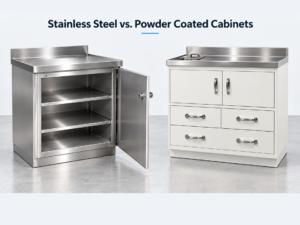
Stainless-steel cabinets remain the most practical surface finish for medical environments. They clean easier, resist corrosion better, pass inspections quicker and for longer, and last 2-3 times longer than powder-coated cabinet alternatives. On top of that, while the upfront cost can sometimes be greater, once you look at cost of replacements in 20-40-60 years its longer product life makes it a much more economical purchase.
Ultraray made the switch from powder-coat to stainless cabinets based on all four factors. Evidently, it made no sense otherwise. Our forty years of industry experience helped us hone lead-lining advice for medical and nuclear medicine builds.
For expert advice on your next build, contact Ultraray.