
Nuclear Lead Castings


Custom nuclear lead castings poured into customer-provided weldments using ASTM-compliant pure lead and controlled hot-pour processes.
Key features and benefits
ASTM B29 / QQ-L-171E pure lead pours – ensures material consistency using recognized specifications
Casting into customer-provided weldments – integrates lead shielding directly into fabricated assemblies
Small to large casting capability – supports projects ranging from minor lead fills to 100,000 lb continuous pours
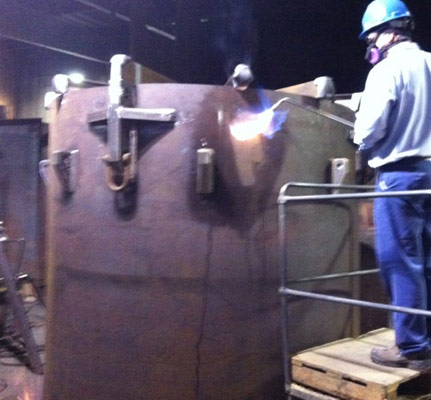
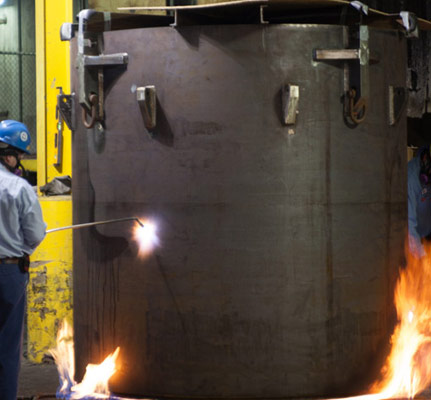
Hot pour tower and elevated kettle system – allows controlled, high-volume lead casting
Continuous pour capability – enables large monolithic shielding components
On-site gamma X-ray testing – verifies casting integrity for quality assurance
Product overview
Ultraray provides custom nuclear lead castings poured into customer-supplied weldments using ASTM B29 and QQ-L-171E pure lead. By working directly with fabricated steel structures or shielding assemblies, we integrate lead shielding into structural components using industry-approved pouring practices and procedures.
We support a wide range of casting sizes. Projects can range from small lead fills to large-scale, continuous pours up to 100,000 lbs. Our hot pour tower and elevated kettle system allow controlled placement of molten lead into weldments, supporting uniform fills and large monolithic shielding structures.
To support quality assurance requirements, all nuclear lead castings include on-site gamma X-ray testing. This inspection process verifies casting integrity and supports documentation for nuclear and industrial applications. Nuclear lead castings should be specified as part of a comprehensive shielding and structural design strategy.
When to use this product
Use this product when:
Lead shielding must be integrated into fabricated weldments
Large monolithic shielding structures are required
Small or large-volume lead fills are needed
Continuous pours are preferred for structural integrity
Quality assurance testing is required for nuclear applications
Where this product is typically found
These castings are commonly used in:
Nuclear power facilities
Nuclear medicine and radiopharmacy installations
Industrial radiation shielding structures
Research and government nuclear projects